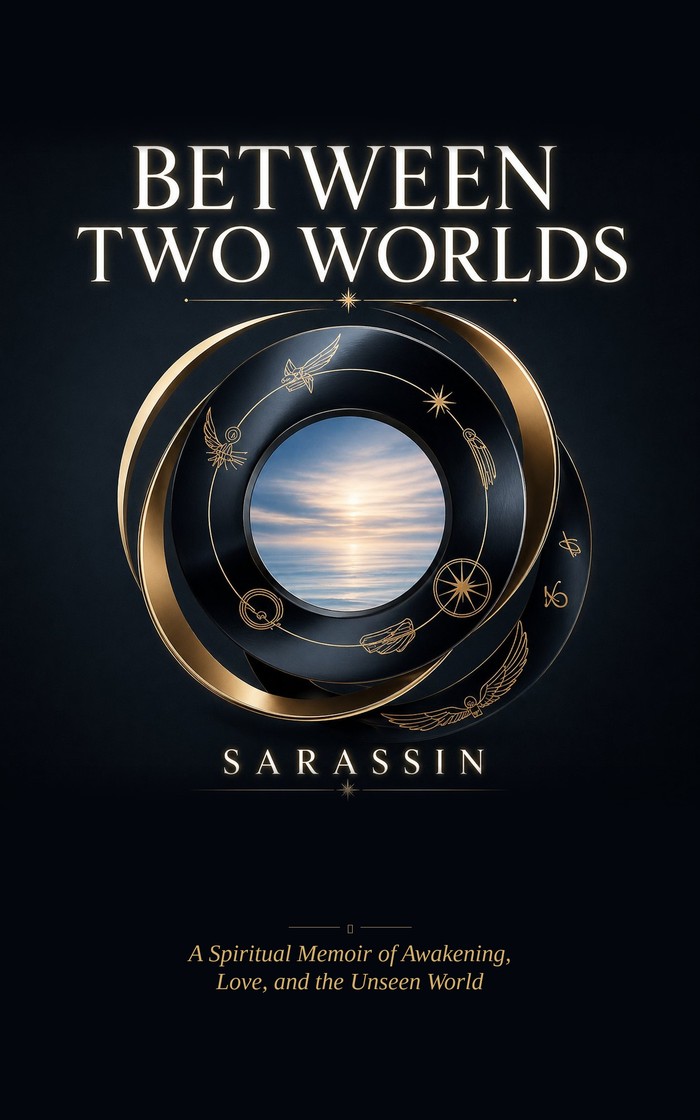
A Memoir of Awakening, Love, and the Unseen World
There is a before and an after. The line between them was drawn on an ordinary weekday, by a bicycle, a hill, and a lamp post. What followed was a life lived across two realities simultaneously. This is a record of what it means to live while perceiving beyond the visible and to remain human within it.
From Chapter One
In the Beginning
I do not mean this as a manner of speaking. I mean it as a precise statement of fact. There is a before and an after, and the line between them was drawn on an ordinary weekday.
The rest of it took time to declare itself. Not all at once, the consequences of that afternoon unfolded slowly, over weeks and then months, each one arriving with the quiet, irrefutable patience of things that are going to happen regardless of whether you are ready for them.
The dark, I discovered, was considerably more populated than I had previously understood. It began with the shadows. Not with alarm, not with anything that should have frightened me, but with the peculiar matter-of-fact intimacy that children have with things they have not yet been taught to be afraid of. They spoke, with a casual familiarity that suggested these were ordinary topics, about quantum particles and Ramanujan's infinite series. The information was real. The concepts were accurate. They were not things an eight-year-old boy in East Dulwich could have assembled from his own resources. The shadows knew things, and they shared them, and they did so with a generosity and an apparent enjoyment that I found, then and now, entirely impossible to dismiss.
I turned back to the bed and froze. There I lay, peacefully asleep, blanket drawn up to my nose, entirely undisturbed. I was looking at myself from the outside. I turned to the shadows and asked, with childlike simplicity and curiosity, whether I was dead. They fell about with what I can only describe as genuine laughter. No. Not dead. Simply out.
We went out into the grey of a London night that was not quite the London night I had lived in or quite remembered, but close enough to be recognisable, and further away from it than any distance could measure. It was the first of a very great many such journeys. I didn't know that yet. I was eight years old, standing outside my own sleeping body, following two entities into an unseen world that was and is as terrifying as it is illuminating, and the most accurate thing I can say about my state of mind at that moment is that I was not frightened at all...
The rest lives inside the memoirs.
This is a direct account of a life shaped by encounters with what cannot be readily explained, documented as they occurred, without revision or interpretation to make them more acceptable.
It is a record of perception extending beyond the visible, and the quiet, often disorienting process of continuing to live within both.
190 pages spanning East Dulwich to Lagos, London to New York, the compliance desks of Swiss Bank Corporation to the stone sanctums of upstate New York. Neither mythologised nor explained away. Rendered as precisely as language allows.
East Dulwich, 1970s. A bicycle accident. A lamp post. The dark side of ordinary consciousness, and what moves there.
The aura arrives. Two ancient beings. The elemental kingdoms and what it costs to approach them with impatience.
A hospital ward. An elderly woman whose silver cord is at its most attenuated. The work that was always going to be the work, and what it feels like to be ten years old and understand this for the first time.
Lagos. A city alive in ways London was not. A hill and an old man in a white kaftan whose aura was luminous in a way that colours are not. The end of a particular quality of loneliness.
Plotinus in the British Library, one grey October. The Hermetic tradition. The Book of Shadows. The moment a map finally arrives for terrain you have been moving through in the dark since childhood.
Central Park West. A warm, clear gold in the lamplight, steady from the Buddha Bar to the final evening. The most disorienting threshold of all: the third world, the human one, the world of another person.
Lake Titicaca at pre-dawn. What appeared on the surface of the water. Sister Marguerite, who, when it was over, said she needed breakfast, which was entirely the correct response.
The Convocation of the Adversary. A quality of vast, cold attention that turns itself upon six people in a circle at midnight with the unhurried thoroughness of something that has all the time in the world.
The whole truth has Claudette in it. What she knew before the letter arrived. What she said at a table in Bryant Park that reached into the innermost chamber of everything.
"Looking back at the child I was in those years, lying awake in the dark with the ringing in his ears and the aura of the street outside visible through the curtains and two ancient beings waiting with infinite patience at the edge of his perception, I find I have a great deal of tenderness for him. He did not know what he was yet. But he was there, night after night, because the world that was available to him when he showed up was more real than the one that was available to him when he didn't. That is not a bad foundation for a life." , Between Two Worlds, Chapter Two
Reading Plotinus in the British Library one grey October was, as Sarassin records, quietly transformative: "Here was a precise account of terrain I had been moving through in the dark, the silver cord, levels of being, the movement of the soul, just without the key." The Neoplatonic tradition is the architecture beneath these memoirs: the understanding that all existence flows from a single inexhaustible source, that the soul's ache is the memory of its own origin, and that beauty is the world's most honest testimony to what it comes from. This is not offered as philosophy. It is offered as the map Sarassin finally found for a journey already underway.
"She asked me if there was a God. I told her she would find out considerably sooner than I would. It was the honest answer and it was also, I hoped, the kind answer, because honesty and the kind do not always coincide but in this instance, they did. She understood the levity of my response, and she laughed. A small, clear laugh, entirely real, one of the most fully alive sounds I have ever heard, and that was her last exhale. The laughter and the leaving were simultaneous. I have always thought there are far worse ways to go." , Between Two Worlds, Chapter Three · The Psychopomp
There is a point, somewhere in this text, where something may recognise itself. If you have felt that already, you do not need further explanation.
I read it in one sitting. Twice. It named things I have never spoken aloud to anyone. I felt witnessed by a book, and somehow, by myself.
A., Lagos, NigeriaThe precision of it undid me. This is not a person who has romanticised their experiences. This is a person who has observed them, rigorously, for fifty years. That rigour is what makes it impossible to dismiss.
M., London, EnglandI have read a great deal of spiritual literature. This is not spiritual literature. This is something more honest, and therefore more useful, than most of it. Unsettling in the best possible way.
R., New York, USA"Outside, in the invisible world that has been my companion and my territory and my responsibility since a lamp post in East Dulwich changed everything without warning on an ordinary afternoon more than fifty years ago, something was moving in the direction of what comes next. As it always has been. As it always will be." , Between Two Worlds · Final lines, Book One
One payment · Immediate access · Yours to keep
A Memoir of Awakening, Love, and the Unseen World.